In 2026, we are focusing heavily on customer support content for online stores using platforms like Shopify. Shopify is currently one of the most widely used e-commerce platforms in the world and dominates a large portion of the modern DTC (direct-to-consumer) e-commerce market.
In our latest article, we taught how to outsource Shopify customer service in the right way. Today, we’re going to teach you how to do the basics.
So what makes Shopify special? It is a platform with a very high level of integration with customer support tools and services. If you are just starting to sell online, this guide will be extremely useful.
What Does Shopify Offer for Basic Customer Support?
When you create a Shopify store, the platform already provides some basic but useful features to help you run simple customer support operations, such as:
- Email notification system – Shopify includes a native system that automatically sends emails to customers when an order is confirmed, refunded, canceled, shipped, and more.
- Contact form – When you create a new page in Shopify, one of the available templates is a standard contact page with a basic contact form that sends submissions to your registered email address. It is somewhat limited, however. You cannot easily add extra fields like department, subject, product name, and other custom options without additional customization.
- Shopify Inbox – Shopify Inbox is Shopify’s native live chat application. It is useful for smaller stores and includes features such as automatic order lookup and a mobile app that allows you to reply to customers directly from your phone. It also supports integration with Meta channels. Learn how to use Shopify Inbox AI here.
With these tools and a few customizations, you can already create a functional support system for a small store. But how do you implement it properly?
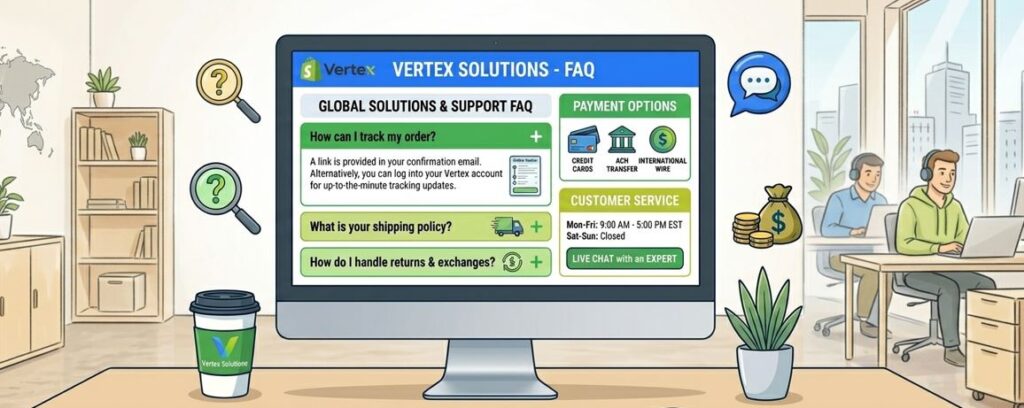
1. Start With a Good FAQ Page
Create an FAQ page divided into sections according to your customers’ most common questions.
For example:
- Logistics: exchanges, delivery times, “Where Is My Order?” (WISMO), returns, tracking, shipping delays, etc.
- About the brand: who you are, where you are located, what you offer, how to contact you, and other basic company information.
- Products: this depends heavily on the type of products you sell. If you sell consumable products like supplements, customers may ask questions such as:
- What is the shelf life after opening?
- Are these products vegan?
- Can pregnant women consume these products?
- Are these supplements safe for diabetics?
You can even create a dedicated FAQ page for each product if necessary.
An FAQ page helps answer questions immediately, supports self-service bots, reduces repetitive tickets, and can later help train your support team. This is why it is important to keep your FAQ updated and consistent.

Order Tracking Reduces a Huge Number of Tickets
One of the most common support questions in ecommerce is simply:
“Where is my order?”
Because of this, investing in good order tracking can dramatically reduce your support volume.
Automatic shipping emails, tracking pages, and apps like AfterShip can help customers track orders themselves without needing to contact support.

2. Use the Customer Support Channels Your Customers Actually Use
When you start promoting your products, you will notice something interesting: the more specific your products and audience become, the more certain sales and communication channels start to outperform others.
That is why understanding where your customers prefer to communicate is extremely important.
Support Channels by Customer Profile
For example, Gen Z customers often use TikTok and Instagram DMs to ask questions or make complaints, while older customers still tend to prefer phone support and email.
Location also matters a lot. In the United States, SMS and iMessage are widely used. In countries like Brazil, customers rely much more heavily on WhatsApp.
The type of device your customers use most often – desktop, smartphone, Android, or iPhone – can also influence which support channels work best.
After a short period of selling and observing competitors in your niche, you will start identifying these customer behavior patterns.
Basic Support Channels
- Email – Always keep a contact email visible on your website.
- Contact form – Add a visible contact button that directs users to your contact page and keep the form simple with only the necessary fields.
- Social media – Use the platforms most relevant to your customer profile.
- Phone support – Optional for some stores, but essential for others depending on the type of products you sell.
Avoid Too Many Support Channels When Starting a Shopify Store
If you are not actively promoting your products on Facebook and most of your customers are not there, you probably do not need Facebook support yet.
A common mistake among new Shopify store owners is trying to provide support on every possible channel from day one. In reality, this can create operational chaos.
The ideal approach is to guide customers toward the channels where you can provide the best and fastest support experience.
Even large companies make this mistake. Sometimes a company offers support through Facebook, but the support agents responding there have no real resolution power. The result is often a public wall of complaints with generic responses like:
“Hello John, we will review your request shortly.”
If you are just starting out, it is usually better to focus on fewer channels that you can control properly.
Set Basic SLA Expectations
SLA (Service Level Agreement) is essentially a set of response expectations you establish for your store.
This can include:
- Average response times
- Support hours
- Priority definitions
- Expected resolution times
You can share some of this information publicly on pages like Contact, FAQ, or even your website footer.
For example, customers should know whether your support team operates until noon on Saturdays but not on Sundays.

Create a Clear Return Policy
Most online stores maintain a dedicated return policy page that explains:
- Return deadlines
- Conditions for returns and exchanges
- Refund policies
- How to initiate a return
The more detailed and accessible this information is, the less overloaded your support team becomes.
Using Macros and Saved Replies
As your support volume grows, using macros and saved replies becomes extremely important.
These are pre-written responses that allow agents to answer common questions much faster.
Examples include:
- Shipping delays
- Refund requests
- Exchange instructions
- Tracking updates
- Damaged product reports
Most modern help desk platforms include macro systems that can dramatically improve productivity and consistency.

Scaling Your Shopify Customer Support
As your store grows and the number of customer requests increases, Shopify combined with a ticketing platform becomes your next step.
In simple terms, these platforms centralize customer interactions from multiple channels into tickets with IDs, tags, priorities, internal notes, and automation features.
This allows your support team to manage all conversations from a single dashboard.
Modern help desk tools can also:
- Detect ticket priority
- Route tickets to specific departments
- Use automation and AI
- Track customer sentiment
- Apply macros and saved replies
- Improve overall productivity

Popular Help Desk Platforms for Shopify Stores
Gorgias
Gorgias is one of the most popular help desk platforms among Shopify merchants.
Its pricing model is generally based on the volume of support tickets handled.
Pricing usually starts around US$10/month for small stores and can scale to hundreds or even thousands of dollars per month for larger operations.
For smaller stores with lower support volume, Gorgias can feel somewhat expensive, but it is often the next step once customer support starts affecting retention and sales.
Main Advantages of Gorgias
- Excellent Shopify integration
- Improves productivity by centralizing support workflows
- Actions inside conversations — agents can refund customers, edit orders, change product variants, and more directly from the ticket interface
- Omnichannel support — email, SMS, Instagram, Facebook, and other channels become centralized tickets
- Macros and automated responses for repetitive questions
- Strong ecommerce-focused automation features
Main Disadvantages of Gorgias
- Ticket-based pricing – Costs can become difficult to predict during periods of high interaction volume.
- Support response time – Depending on the plan and ticket volume, some businesses consider the platform support slower than expected.
- Complex integrations – Shopify integration is simple, but logistics or marketing integrations may require additional setup work.

Zendesk
Zendesk is one of the most popular and widely used customer support platforms in the world, including among ecommerce businesses.
It can be integrated with Shopify through an official app and offers a much more enterprise-oriented structure.
Zendesk pricing is generally agent-based rather than ticket-based.
Basic plans usually start around US$20 per agent/month, while omnichannel plans with AI, chat, voice, and advanced automation can range from approximately US$55 to over US$115 per agent/month.
However, advanced AI and workforce management add-ons may require additional costs.
Main Advantages of Zendesk
- Advanced ticket routing – You can create highly customized ticket distribution rules.
- Advanced knowledge base system – Zendesk offers a more robust FAQ/help center structure.
- Multi-brand support – Useful for businesses operating multiple stores across different platforms like Shopify and WooCommerce.
Main Disadvantages Compared to Gorgias
- Editing Shopify orders directly inside tickets often requires additional integrations.
- Refund actions also usually depend on external apps.
- Some ecommerce marketing integrations may require API configuration instead of native apps.
Other Help Desk Platforms Worth Mentioning
Although Gorgias and Zendesk are among the most popular options, there are several other good customer support platforms for Shopify stores, including:
- Freshdesk – Good cost-benefit ratio for small and medium businesses.
- Re:amaze – Ecommerce-focused platform with strong Shopify integration.
- Help Scout – Popular among smaller brands looking for a cleaner and more human support experience.
- Kustomer – Modern customer service platform focused on omnichannel support and larger ecommerce operations.
Each platform has different pricing models, integrations, automation features, and operational styles.
Conclusion
For stores in their first few months with low sales volume, we usually recommend starting with simpler support channels such as email, live chat, social media support, and manual request management.
As your store grows and interactions increase, even a simple ticketing platform can become extremely valuable.
If you are looking for fluent English-speaking agents to outsource your Shopify customer support, feel free to contact us. We offer Shopify customer support services with excellent cost-efficiency and quality.
We hope this article was helpful.