Article updated on 06/01/2026.
Your Shopify store starts selling more, and with that, you face the following dilemma: you can no longer keep up with basic customer support, and it’s time to outsource it.
OUTSOURCE YOUR SHOPIFY CUSTOMER SERVICE WITH BRAZILDESK, CLICK HERE!
Orders pending review, customers asking where their products are, returns, and people complaining on other channels that your store is falling short. Over time, all these sales can start to decline because customers cannot reach you. And using AI and automated bots alone is not enough. You need a support team.
In the US, it is very common for Shopify store owners to outsource their customer support. This allows them to focus on marketing, store growth, products, and especially logistics. After all, you wanted to build a successful store, right? And the success of an e-commerce business is no different from a physical store.
Customer service matters. If you do not serve your customers well, they will not come back.
However, there is one important point. Hiring a support agent can cost between $17 to $26.92 per hour, while outsourcing to other countries can reduce this cost to around $10 to $15 per hour, almost a 50% reduction.
In this article, we will cover everything about offshore customer service outsourcing for Shopify stores.
What is Offshore Customer Support for Shopify?
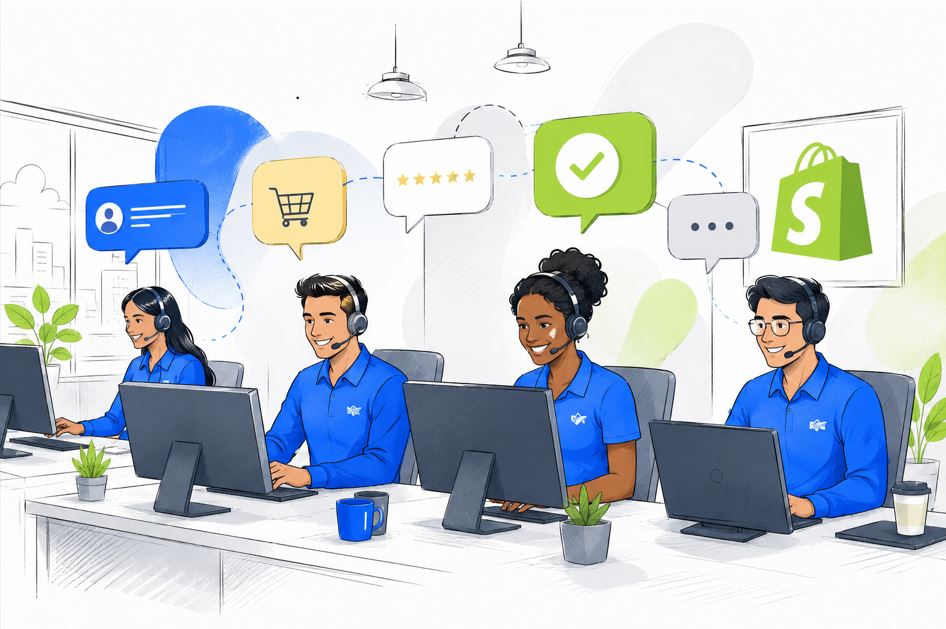
Simple. It is when you outsource your customer support to a company located in another country, such as the Philippines, India, or Brazil, as is the case with BrazilDesk.
Many companies offer plug-and-play solutions, where you connect them to your systems, for example Zendesk or Gorgias, and they handle all your store support operations, providing periodic performance reports.
What Services Are Included?
When we talk about outsourcing for Shopify stores, we are referring to services such as:
- Email support: Gmail, Zendesk, Gorgias
- Live chat
- Social media DMs Instagram, Facebook
- Order tracking and updates
- Refunds and returns
- Dispute handling (chargebacks), PayPal, Stripe
- Product inquiries
- Upselling and cross-selling
Each store has specific needs depending on its business model. Most stores today offer omnichannel support, and Shopify integrates easily with a range of tools. That is why finding a company specialized in Shopify outsourcing should be your main focus.
Why Outsource Shopify Support to Another Country?
There are basically two main reasons: cost and language.
As mentioned, outsourcing can reduce hourly costs by up to 50%, in addition to eliminating several expenses related to hiring an in-house employee when you’re in the US, CA, or Europe, for example.
The second factor is language.
This becomes especially valuable if you serve customers whose first language is not English.
Another important point is that you are paying for a complete package tailored to your business, without the stress of constantly training new hires or dealing with administrative overhead.
Ideally, you should work with a company that has experience with Shopify and tools commonly used in the ecosystem, such as Gorgias, Zendesk, and Freshdesk. Depending on the provider, they may even handle the full setup and customization of your support system. You pay and receive reports.
Things You Should Be Careful About
Everything depends on the type of store you have, and the product you’re selling.
If you require near native spoken English, it is important to request this from the provider. If most of your support is text-based, then the priority should be ensuring agents have excellent written English and can follow your brand tone of voice; accent won’t be a big problem as long as the agent types correctly.
If this is your first time outsourcing, the best approach is to clearly define procedures with the provider, request a trial period, or start with a smaller team.
Best Countries to Outsource Shopify Support
For North American stores, keeping outsourcing geographically closer can be advantageous due to time zones and cultural proximity. Mexico, for example, can operate in the same time zone, and Brazil is only a few hours ahead of Florida.
One challenge with more distant regions like the Philippines or India is that when your business is active, their teams may be working overnight shifts. While this is common in the industry, some studies suggest that performance and attention levels can be affected during night hours.
That said, this is just one factor.
Ultimately, any company that provides qualified agents and ensures efficient support can be a strong partner.
How to Outsource Your Shopify Support
Everything starts with research. If your goal is to optimize cost, you can request quotes from different Shopify support providers.
There are several pricing models, depending on your business and the provider:
1. Cost per Ticket
In this model, you pay a fixed amount per resolved ticket, whether email, chat, or support request.
Average cost between 1 and 20 dollars per ticket, depending on complexity and business type. This model requires careful configuration to avoid unexpected costs.
Advantage. Costs scale with demand. If there are no tickets, there is no cost.
Disadvantage. Agents may prioritize speed over quality, especially for complex issues.
2. Cost per Agent
You hire one or more agents who work exclusively for your company.
Average cost between 1500 and 2500 dollars per agent per month, depending on experience.
Advantage. The agent develops deep knowledge of your product, brand, and tone of voice.
Disadvantage. Fixed cost. Even during low-demand periods, you continue paying the same amount.
3. Shared Agents
Agents handle multiple companies at the same time. This is common for small and medium ecommerce businesses.
Average cost is typically charged per hour between 10 and 20 dollars or through monthly plans.
Advantage. More affordable than dedicated agents.
Disadvantage. Response times may be slower during peak demand periods.
Which Model Is The Best?
It depends on your ticket volume and average order value.
You can also combine models. For example, maintaining a fixed team while adding shared agents during peak seasons.
2026 Trend Hybrid Model
Many ecommerce companies are using AI for Tier 1 support, simple questions like where is my order, while dedicated agents handle Tier 2 issues, complex or sensitive cases.
What You Need to Provide
To successfully outsource your support, you need to prepare your operation:
Team Manager or Account Manager
Someone on your side should manage the relationship with the outsourcing company. Some outsourcing companies already provide a Team Manager to support the whole operation, and that can be discussed.
SOPs
Clear documentation is essential. Agents need step-by-step instructions, FAQs, and updated information about your store.
Access and Permissions
Tools like Zendesk, Freshdesk, and Gorgias require proper access control and configuration.
Feedback
The outsourcing team needs continuous feedback, especially during the initial phase.
Training
Even experienced agents need onboarding related to your products and processes.
Final Considerations
Outsourcing your Shopify store support can be highly effective when done correctly.
By working with an offshore team, you reduce costs and gain a scalable partner to grow with your business. However, it is essential to track KPIs such as CSAT and ensure service quality meets your standards.
If you are looking for a specialized Shopify support company, contact us. BrazilDesk can build a dedicated team for your store at a competitive cost and high quality, without operational headaches or losing customers.
We hope this 2026 guide helps you improve your Shopify customer support strategy.